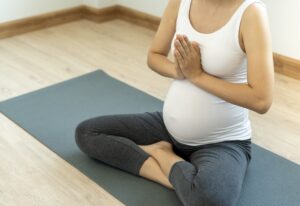
Pregnancy brings incredible changes to your body—and sometimes a few aches, pains and stresses along with them! Prenatal yoga can be a gentle way to stay active while also giving yourself time to slow down, breathe and connect with your growing baby.
Prenatal yoga combines gentle stretching, strengthening, breathing and relaxation exercises that can be adapted as your pregnancy progresses. For many expectant moms, it’s also a welcome opportunity to step away from the busyness of everyday life and simply focus on themselves and their babies.
If your healthcare provider has given you the go-ahead to exercise during pregnancy, here are 10 prenatal yoga poses you may want to explore.
1. Cat-Cow Stretch
The Cat-Cow Stretch is a gentle movement that can feel especially good when your growing belly begins putting additional strain on your back.
Starting on your hands and knees, alternate between gently rounding your spine and allowing it to return to a comfortable, neutral or slightly extended position. Move slowly and coordinate the movement with your breathing.
This exercise promotes gentle spinal mobility and may help relieve some of the back tension that can accompany pregnancy. As your belly grows, keep your movements comfortable rather than trying to achieve the deepest possible stretch.
2. Warrior II
Want to feel strong? Warrior II may be the prenatal yoga pose for you!
This standing pose helps strengthen your legs while encouraging openness through the hips. Strong legs can be helpful throughout pregnancy, especially as your body adjusts to carrying additional weight.
Begin with your feet comfortably apart, turn one foot outward and gently bend that knee while keeping the other leg extended. Raise your arms parallel to the floor if comfortable.
Remember that your balance and flexibility can change during pregnancy. Shorten your stance or practice near a wall or sturdy chair if you would feel more secure with extra support.
3. Tree Pose
Pregnancy changes your center of gravity, which can make balancing poses more challenging than they once were. Tree Pose provides an opportunity to practice balance, concentration and calm—but safety comes first.
Stand beside a wall or sturdy chair for support. Shift your weight to one foot and place your other foot against your ankle or lower leg. Avoid placing pressure directly against your knee.
There’s no prize for balancing without assistance! Using a wall, chair or other support can help you enjoy the benefits of the pose while reducing your risk of falling.
4. Seated Forward Bend
A gentle seated stretch can provide a peaceful moment to breathe and release tension.
During pregnancy, however, a traditional forward bend will probably need some modification to make room for your growing belly. Sit with your legs comfortably apart rather than trying to fold over tightly closed legs. Keep your spine long and hinge forward only as far as feels comfortable.
You don’t need to reach your toes. The goal is gentle movement and relaxation—not achieving a particular position.
5. Legs-Up-The-Wall
Tired legs and feet are familiar territory for many pregnant women. A modified Legs-Up-The-Wall pose can provide a chance to rest and take pressure off your feet.
Later in pregnancy, however, lying flat on your back for extended periods may not be recommended. Instead, ask your prenatal yoga instructor or healthcare provider about pregnancy-safe modifications, such as using bolsters or pillows to keep your upper body elevated or choosing a comfortable side-lying alternative.
Most importantly, listen to your body. If you feel dizzy, lightheaded, short of breath or uncomfortable, change positions.
6. Pigeon Pose
Pregnancy can bring tightness and discomfort around the hips and lower back. Pigeon Pose is traditionally used as a hip-opening stretch, but pregnancy is not the time to push your flexibility.
The hormone relaxin helps prepare your body for childbirth by loosening ligaments, which can make it easier to overstretch without realizing it. A prenatal instructor may recommend a supported or modified version of Pigeon Pose using cushions, blocks or another position that provides a gentler hip stretch.
Never force yourself deeper into a pose simply because you were able to do it before pregnancy.
7. Child’s Pose
Sometimes you simply need to rest—and Child’s Pose is made for those moments.
From your hands and knees, move your hips gently back toward your heels while keeping your knees wide enough to comfortably accommodate your belly. You can use pillows or a bolster for additional support.
Take several slow, comfortable breaths and allow yourself to relax.
Child’s Pose can provide a wonderful opportunity to practice the type of intentional breathing and relaxation that may also be helpful during labor.
8. Side Angle Pose
A modified Side Angle Pose can help strengthen the legs while gently opening the hips and side body.
From a comfortable standing position, bend one knee and bring your forearm toward your thigh rather than attempting an intense twist or deep stretch. Extend the opposite arm if that feels good.
Again, pregnancy yoga is about supporting your changing body—not testing its limits. Use a wall, chair or yoga block whenever you need additional stability.
9. Butterfly Stretch
The Butterfly Stretch is simple, relaxing and easy to modify.
Sit comfortably and bring the soles of your feet toward one another, allowing your knees to fall outward naturally. Sit tall and breathe deeply.
Don’t push your knees toward the floor. Allow gravity to do the work and stop if you experience pain or uncomfortable pressure.
This pose gently stretches the inner thighs and hips and can be a relaxing addition to your prenatal exercise routine.
10. A Pregnancy-Safe Relaxation Pose
Traditional Corpse Pose, or Savasana, usually involves lying flat on your back. As pregnancy progresses, however, a side-lying or supported position may be more comfortable and appropriate.
Use pillows or bolsters to support your head, belly, back and legs. Then close your eyes, breathe slowly and intentionally relax your muscles.
This may be one of the simplest parts of prenatal yoga, but don’t underestimate its value. Pregnancy can be a busy season filled with appointments, preparations and plenty of thoughts about what lies ahead.
Give yourself permission to be still.
You might use these quiet minutes to focus on your breathing, notice your baby’s movements or simply enjoy a peaceful moment together.
Prenatal Yoga Is About More Than Flexibility
You certainly don’t have to be an experienced yogi—or particularly flexible—to benefit from prenatal yoga.
The goal isn’t to perform every pose perfectly. Instead, prenatal yoga can be an opportunity to gently strengthen your body, maintain mobility, practice relaxation and become more aware of your breathing.
Those relaxation and breathing skills may also become useful tools when labor begins.
Just as importantly, prenatal yoga provides intentional time to connect with your baby. Amid nursery preparations, doctor appointments, baby showers and everything else that comes with getting ready for a new arrival, a few quiet minutes can become a welcome part of your day.
Every pregnancy is different, so what feels wonderful for one mom may not feel right for another. Your comfort and safety—and your baby’s—always come first.
Before beginning prenatal yoga or any new exercise program during pregnancy, talk with your healthcare provider. Consider taking a class specifically designed for pregnant women and led by a qualified prenatal yoga instructor who can show you appropriate modifications for each trimester.
Then breathe, move gently and enjoy this special time as you prepare to welcome your little one!
Source:
American Pregnancy Association. Prenatal Yoga.
https://americanpregnancy.org/healthy-pregnancy/pregnancy-health-wellness/prenatal-yoga-1071/
Previously appeared on Newsymom.